

HUANGSHAN CHAIN TECHNOLOGYPart of SFR Group · Established 2011
An Industrial Chain Supplier for Drive, Conveying and Lifting Needs


Walk through a production site and you may find one chain turning a shaft, another carrying a fixture and a third working in a lifting mechanism. Ordering all three as “industrial chain” loses the distinction that determines whether the replacement will do its job. HCC CHAIN is an industrial chain supplier with published roller, conveyor, leaf and specialist chain products, supported by chain manufacturing and inspection capabilities in Huangshan, China.
For a maintenance buyer or machinery builder, first identify what the chain must do, then record the series, dimensions, attachments and operating conditions. Begin with our industrial and specialist chain range. It includes named transmission and conveyor references that help turn an unclear request into a product discussion grounded in the actual machine.
An industrial chain supplier should separate the machine’s three jobs
Power transmission, conveying and lifting can occur within the same factory, but they do not create one interchangeable chain requirement. A transmission chain works with sprockets to transfer motion. A conveyor chain may also carry attachments or run on a supporting path. A leaf chain uses a plate-and-pin construction associated with lifting and counterbalance systems. The purchasing description should preserve those functional differences.
HCC’s range gives the buyer several clear entry points: A- and B-series roller chains for transmission, M-series and double-pitch products for conveying, and leaf chains for the appropriate lifting mechanism. Our ability to discuss these families together can simplify supplier coordination. Engineering approval should still remain specific to the chain’s function and the equipment that uses it.
Imagine a maintenance department taking responsibility for machines purchased at different times. Some spare-part records contain complete chain designations, while others contain only photographs. The efficient first step is to separate the machines by function and recover the available product references. A single supplier conversation can then address several identified requirements without assuming that similar-looking chains are equivalent.
For a shaft drive, start with the roller-chain series
HCC lists A-series short-pitch precision roller chains, including 08A / 40 and 16A / 80, alongside B-series 06B and 08B products. Several references include single-, double- and triple-strand arrangements. Those published identifiers are useful to a maintenance buyer because they establish more than a visual resemblance: they point to a particular chain family and configuration for review.
Keep 08A / 40 and 08B references distinct
The characters in the designation matter. A buyer should not reduce 08A / 40 and 08B to a shortened “08 chain” request. Record the installed chain identification and the corresponding sprocket information. If the machine records are incomplete, a drawing, sample details or dimensional information can support a technical review, but the series should not be guessed from a photograph.
For a replacement order, preserve the established drive requirement before considering a different construction. For a new machine, the design team needs to define the load, speed and operating environment. HCC’s product selection provides candidate references; it does not replace the engineering work that establishes the required drive. A chain should be chosen for its approved duty, not because its outer plates appear larger.
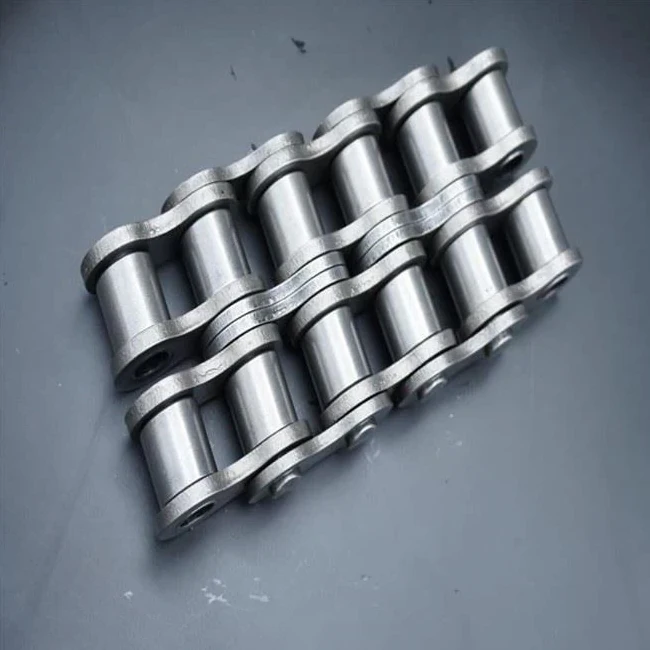
Treat strand count as part of the 16A / 80 order
Our 16A / 80 range includes single-, double- and triple-strand configurations. If a buyer is replacing a multi-strand chain, that arrangement belongs in the item description together with the series and required length. The installed sprocket configuration and available space should remain part of the application record.
A machinery builder may consider different drive layouts before settling on one arrangement. In that situation, the chain discussion should follow the design calculation and the confirmed installation envelope. A multi-strand product is not simply a universal upgrade that can be substituted after the machine has been built. The published HCC options allow comparison; the selected drive determines which option is suitable.
Explain the lubrication conditions with the roller-chain duty
The operating environment helps determine which questions need attention during chain selection. Dust, exposure and the available lubrication arrangement can affect how a drive is maintained. Describe those conditions to HCC along with the chain reference. A purchasing line containing only a size number leaves the supplier without context for discussing the intended application.
Renold’s lubrication guidance explains why lubricant needs to reach the working chain joints. Its recommendations are useful engineering background, but its product-specific lubricant choices or life expectations should not be adopted as HCC promises. Follow the requirements established for the actual chain and machine rather than applying a universal maintenance assumption.
A conveyor-chain order must describe the path and the attachment
Conveying introduces questions that a transmission-chain designation alone may not answer. HCC’s published selection includes M-series conveyor chain, K1 / K2 attachment chain, C2040–C2080 small-roller products, C2052 large-roller chain and C2042 large-roller attachment chain. The useful choice depends on the conveyor arrangement and the way the load is supported or connected.
A second buyer situation is a plant replacing chain on a fixture conveyor. The existing attachment spacing controls where each fixture sits, while the conveyor path determines how the chain is guided and supported. A replacement that matches only an overall length may still leave the attachment or roller arrangement unresolved. The order needs the drawing details that connect the chain to the machine.
K1 and K2 attachments need a documented mounting requirement
HCC lists K1 / K2 attachment conveyor chain for mounting fixtures in material-handling systems. The attachment description is a starting reference, not a complete representation of a customer’s fixture. Include the mounting dimensions, spacing, orientation and relevant conveyor drawing so that the proposed product can be reviewed against the actual connection.
If the installed chain uses a non-standard attachment, HCC also welcomes custom chain discussions based on drawings or sample details. That route is more appropriate than assuming a standard attachment can be altered on site without affecting the machine requirement. Define the required geometry first, then discuss whether a published configuration or a custom review is the right path.
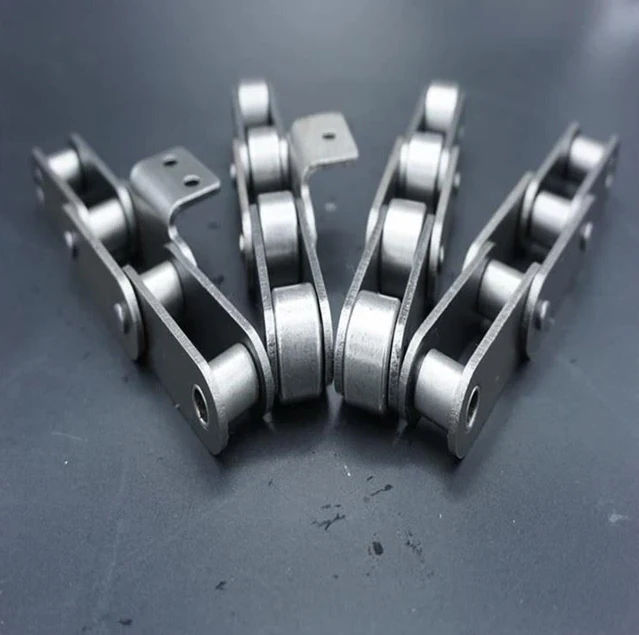
The distinction between the C2040–C2080 small-roller group and a large-roller product such as C2052 should likewise remain visible in the purchase description. A buyer should identify the supporting path and the required roller configuration rather than treating the family names as different labels for one chain. The Renold engineering literature collection offers broader transmission and conveyor-chain background; HCC’s own references define the range being proposed here.
Leaf chain belongs to its own lifting-system review
HCC publishes leaf chains for lifting and counterbalance applications. The selection concerns a plate-and-pin chain rather than a roller chain intended to mesh with a conventional transmission sprocket. The plate arrangement, pin dimensions, connection details and required load are therefore important inputs when the equipment’s approved replacement is identified.
For a lifting mechanism, the equipment documentation and responsible technical personnel should establish the acceptable chain and replacement procedure. A public product photograph does not state a working load for every assembly. HCC’s leaf-chain offering supports an enquiry, but the buyer must provide the actual application and approval requirements before treating a proposed chain as suitable.
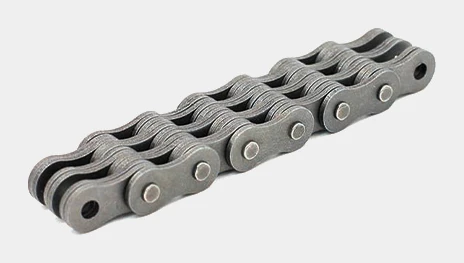
A plant buying roller chains and leaf chains at the same time can coordinate the commercial order while retaining separate acceptance requirements. That separation is especially useful at goods receipt: staff should be able to identify the leaf-chain item and its equipment reference without interpreting it through a generic transmission-chain description. Combining suppliers does not mean combining technical responsibilities.
Use HCC’s specialist chains when the application calls for them
The wider range includes stainless steel chains, carbon steel bushed roller chains, bush chains and non-standard custom chain examples. These options can matter when the operating environment or attachment arrangement differs from an established catalogue drive. The product family should follow the application question, rather than being chosen because the material name sounds more advanced.
For a corrosion-sensitive environment, describe the exposure conditions and required duty before discussing a stainless steel chain. HCC’s public information does not specify a universal stainless grade or a blanket food-contact approval. Material suitability and mechanical requirements must be reviewed together. A chain chosen to address corrosion still needs to meet the machine’s functional requirement.
For an attachment problem, the custom chain route may be more relevant than a material change. Send the geometry and operating conditions that make the standard product unsuitable. The useful result is a technical review of a defined problem, not an open-ended request for a “stronger” chain without dimensions or service context.
The manufacturing resources behind HCC industrial chain supply
HCC’s Huangshan operation combines chain development, manufacturing and inspection, with high-speed precision presses, mesh-belt heat treatment equipment and automatic assembly lines described in its manufacturing overview. For an industrial buyer, these resources provide a concrete basis for discussing components, assembled products and the checks needed for the order.
The company profile records IATF 16949 quality management certification and shows dimensional, material and mechanical inspection facilities. Request the current documents relevant to supplier qualification, then identify the evidence required for the actual 08A / 40, conveyor or custom chain under review. A quality-management certificate and a product acceptance record answer related but different questions.
Order planning should preserve those product differences as well. A repeat 08B roller-chain requirement may be fully identified, while a custom conveyor attachment is still being reviewed. Discuss quantities and preferred delivery timing at the item level. For a mixed shipment, agree product identification and any packaging requirements so the receiving team can distinguish the chain families and their approved machine references.
Our overview of coordinated chain and sprocket supply considers how different product lines can share a commercial discussion. For buyers qualifying the factory across multiple businesses, HCC’s motorcycle chain manufacturing article provides another view of the published production resources; its vehicle-specific approvals remain separate from industrial machinery requirements.
Build your industrial chain order from the machine list
Begin with the shaft drives, conveyors and lifting mechanisms you can identify. For each, connect the installed or proposed chain reference to the machine drawing and operating requirement. HCC’s roller, conveyor, leaf and specialist ranges then become practical routes for discussion rather than a collection of similar-looking products.
The benefit of a broad industrial chain supplier is the ability to address several defined applications within one manufacturing relationship. Keep the definition of each job intact, and use HCC’s product range and inspection resources to resolve the differences that matter. That gives a maintenance team or machinery builder a supply plan that follows the equipment, rather than forcing the equipment into an incomplete purchase description.