

HUANGSHAN CHAIN TECHNOLOGYPart of SFR Group · Established 2011
Take a Non-Standard Attachment to a Custom Chain Manufacturer

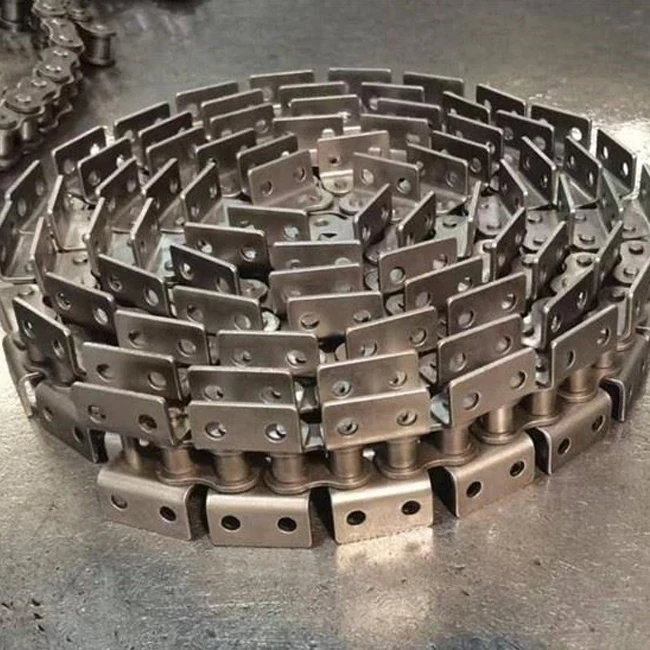
A fixture that will not line up with a catalogue attachment is a good reason to speak to a custom chain manufacturer. It is not a reason to order an undefined “special chain.” HCC CHAIN lists non-standard chain products alongside K1 / K2 attachments, agricultural chains, bush chains and other industrial families, giving machinery builders a practical starting point for a drawing-led discussion.
Begin with the HCC custom and industrial chain range. Explain which interface the catalogue product does not satisfy, what must remain unchanged and how the chain works in the machine. The more precisely the difference is defined, the more useful the manufacturer’s review can be.
Tell the custom chain manufacturer what the standard product cannot do
A custom enquiry should begin with the actual constraint. The attachment may need to connect to a fixture with a different hole arrangement, the available space may limit the assembly envelope, or the chain may need a defined pattern along its length. State the constraint rather than assuming that the word custom communicates the engineering problem.
HCC’s K1 / K2 attachment chains and S55 agricultural attachment chain are useful references when describing the general product route. They can show the type of connection being considered without becoming the specification for the new part. Mark the catalogue example as a reference and the drawing as the proposed requirement where that is the intended relationship.
Start a custom attachment drawing at the fixture connection
The fixture interface is often the reason a standard attachment is unsuitable. Show the relevant working face, hole positions and orientation in a dimensioned drawing. Include enough of the chain relationship to explain how the attachment is mounted, rather than sending an isolated bracket image that leaves the assembly unclear.
Imagine a machine builder who has already designed the carried fixture around a particular connection. The builder should explain which fixture dimensions are fixed and whether any can be reconsidered. That allows HCC to review the chain requirement without assuming that every feature of the surrounding machine is open to change.
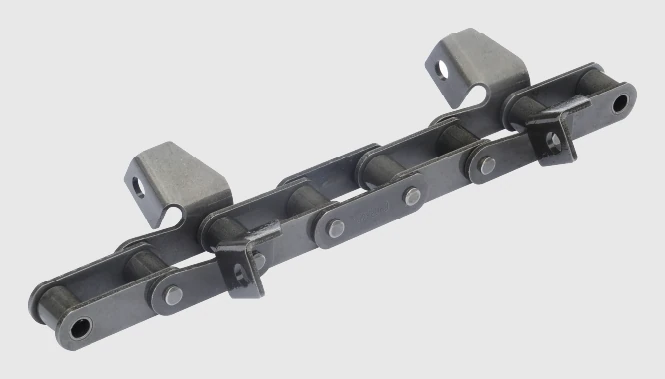
A custom attachment does not remove the need to define the base chain
The attachment and the base chain have different jobs in the specification. The attachment connects to the machine or carried component; the chain must satisfy its own dimensional and operating requirements. Keep the two definitions connected so a change to the attachment does not conceal an unreviewed change to the chain.
HCC lists standard roller-chain references including 08A / 40, 16A / 80, 06B and 08B, as well as bush and carbon-steel bushed roller chains. These are useful construction references, not interchangeable foundations for every custom project. The required family and configuration should be reviewed against the machine’s actual duty.
Distinguish a bush-chain requirement from a roller-chain assumption
HCC shows bush chain separately from other roller-chain products. If the proposed project uses that construction, retain it in the technical description. A buyer should not let a generic chain drawing or purchasing label silently introduce rollers or another construction that the machine does not require.
The supplier needs to know which features define the existing system and which changes are being requested. If the buyer is unsure of the original construction, identify that uncertainty and provide reliable machine information. A custom order should resolve uncertainty, not preserve it inside a new part number.
Explain the exact departure from a K1 / K2 attachment example
A K1 / K2 image can communicate an attachment-chain concept quickly, but the new design may differ in geometry, orientation or spacing. State those differences explicitly. The manufacturer should be able to see whether the enquiry is a standard configuration, an adaptation or a substantially new assembly.
Renold’s standard attachment information illustrates why attachment forms are identified separately in professional chain ranges. It is useful background for organising the enquiry. Its product dimensions and proprietary options should not be presented as HCC’s confirmed manufacturing offer.
The custom chain must clear the whole machine path
A new attachment may fit the fixture in one position and still encounter a problem elsewhere in its travel. Provide the relevant machine layout, including the working run, return and surrounding components. The responsible designer should assess the complete path rather than approve the chain from a static assembly photograph.
A second project scenario involves extending an attachment to carry a changed component. The extension solves the working-position connection but may alter the swept envelope. The drawing package should identify that change and any clearance requirements before the manufacturer is asked to produce the revised chain.
Where the machine uses related chains, explain their required relationship. Attachment spacing or orientation may need to agree across the assembly. The buyer should define that relationship through the machine design and confirm the requested supply configuration with HCC, rather than assuming separately ordered lengths will automatically create an approved set.
HCC’s C2042 large-roller attachment and C2052 large-roller conveyor references can help explain a support-related requirement. They remain separate candidates until the roller, track and attachment interfaces are reviewed. A custom attachment does not automatically make the supporting chain suitable for every conveyor arrangement.
Give the custom chain manufacturer the duty that the drawing cannot show
A drawing can define geometry without describing the operating load, speed, cycle or environment. Provide those inputs where relevant to the chain selection. A manufacturer cannot establish application suitability from a bracket shape alone, and the buyer should not expect an unpublished load rating to appear merely because the part is custom.
If material is part of the project, state the requirement or the conditions that need review. HCC’s stainless-steel offering creates a possible discussion route, but the public range does not confirm every grade or every stainless attachment combination. Keep the material decision separate from the geometric change until both have been reviewed.
Tsubaki’s custom conveyor-chain overview shows the industry’s use of made-to-order chain for specific applications. That supports the general idea of application-led development, not a promise that HCC can supply every illustrated design or reproduce another manufacturer’s performance.
For an existing machine, explain why the change is being requested. A damaged old attachment, a revised fixture and a new operating duty are different problems. The appropriate response may differ, so the project should not begin with the assumption that a stronger-looking plate is the answer to all three.
HCC’s manufacturing resources support a reviewable custom-chain brief
HCC presents precision forming, heat treatment and assembly resources in its production capabilities. Its inspection resources include dimensional measurement, material examination and mechanical testing. These capabilities give the buyer a manufacturing basis for discussing a defined custom part.
The practical value is the ability to connect a drawing to a production and evidence discussion. Which features must match the fixture? Which chain construction is proposed? What information is required before feasibility or sample arrangements can be confirmed? The answers should relate to the actual custom assembly rather than a generic promise of unlimited customisation.
The HCC company profile provides context for the organisation behind the project. Overall capacity and factory scale are not a guaranteed development schedule for a new attachment or chain construction. Agree the scope and review requirements before treating a desired delivery date as confirmed.
If a sample is made available, define what the buyer will evaluate. Dimensional fit, appearance and application performance are different review activities. The sample record should state which decisions have been made and which remain with the machine’s engineering authority before production use.
Keep custom-chain revisions from becoming several unnamed versions
A useful custom-chain drawing distinguishes dimensions that locate the fixture from dimensions that describe the base chain. If the fixture connection is the reason for the project, make that interface easy to find. The manufacturer should not have to discover the critical relationship by comparing several unlabelled photographs or by measuring a worn sample whose intended role is unclear.
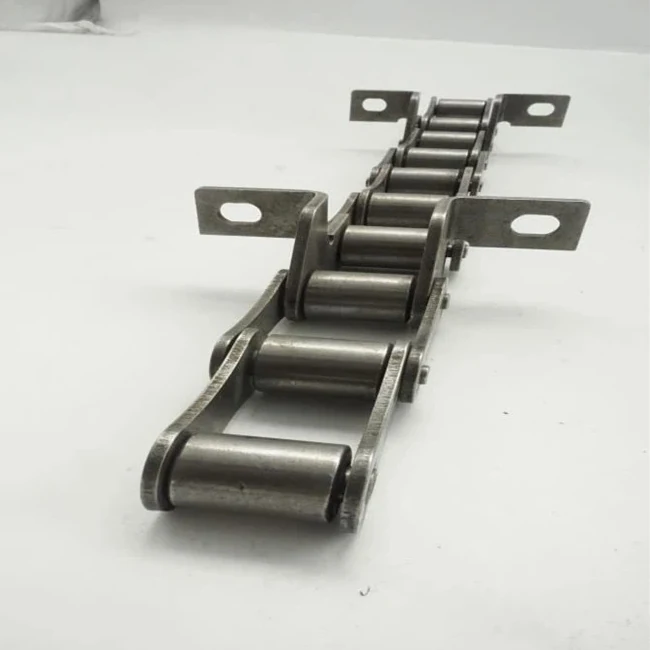
For an S55-related attachment enquiry, retain the agricultural-chain starting reference while showing the requested difference. For a K1 / K2-based concept, identify whether the attachment geometry, spacing or another feature is changing. These are different development briefs even if both are described commercially as custom attachment chain. The more specific description helps the supplier review the actual departure from its published range.
It is also useful to state what is not changing. If the machine’s existing chain path and drive arrangement must remain, say so. If the fixture can be redesigned, identify that flexibility. A manufacturer can offer a more relevant response when it knows which constraints are fixed instead of assuming the buyer wants an exact copy of every visible feature.
That clarity can reduce unnecessary sample iterations without promising a particular development time. Each review then answers a defined question about the attachment or chain assembly, rather than reopening the entire machine design.
Custom projects often involve a drawing, a sample and several photographs. Give each relevant version a clear identity. If the fixture hole position changes, update the drawing and the order description rather than relying on a note attached to one image. The manufacturer and buyer should be able to identify the same current requirement.
State whether a sample illustrates the general concept or represents the approved part. A concept sample may be useful without being ready for production. Confusing those roles can lead purchasing to order a version that engineering still intends to change.
For packing, explain the geometry that needs protection and the way the chain will be received or assembled. Projecting attachments and paired configurations may require different handling discussions from a simple transmission-chain length. Confirm the actual arrangement with HCC rather than assuming a universal package.
Our industrial chain function guide can help the project team keep the chain’s job visible while custom details are developed. The finished brief should still explain whether the chain transmits motion, carries a fixture or serves another defined purpose.
A good custom-chain project closes the gap between the machine and the catalogue without creating a new ambiguity. HCC’s non-standard range and manufacturing resources provide the starting capability. The buyer’s contribution is a clear explanation of the required difference, its operating context and the version that has been approved. That is how a one-off enquiry becomes a part that can be understood and ordered again.