

HUANGSHAN CHAIN TECHNOLOGYPart of SFR Group · Established 2011
From Attachment Geometry to an Agricultural Chain Manufacturer’s Review

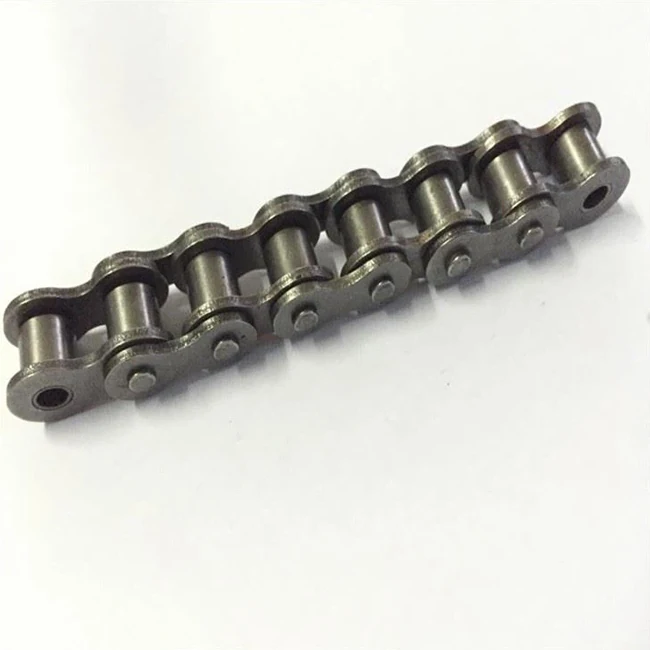
An attachment that is only slightly different can change whether a chain works in an agricultural mechanism. The base chain may look familiar, but the working bracket, hole position or attachment sequence may not match. HCC CHAIN gives machinery builders a practical agricultural chain manufacturer to evaluate through its S55, CA555 C6EJ and S38-K / S38-F products, together with a published non-standard chain offering.
For a drawing-led farm-machinery project, begin with the HCC agricultural-chain range. Identify the base chain and show how its attachments connect to the machine. The manufacturer needs that relationship before a sample or quotation can represent the part the engineering team actually intends to approve.
The agricultural chain manufacturer’s review starts where the attachment meets the machine
A useful drawing does more than show an attachment in isolation. It explains the attachment’s orientation on the chain and its relationship to the component being carried, moved or driven. Hole locations, working faces and the direction of travel can all matter to the interpretation of the part, depending on the mechanism.
Imagine an equipment builder adapting an existing agricultural assembly. The replacement chain uses a familiar base reference, but the fixture connecting to it has changed. Reordering the previous chain without describing that interface change may reproduce the wrong attachment. The revised fixture and chain requirement should be reviewed together before the manufacturer is asked to produce another sample.
HCC’s named agricultural references make the discussion more concrete. S55 with attachments, CA555 C6EJ and S38-K / S38-F are not merely examples of “strong chain.” They provide starting identities that can be related to an actual machine drawing. The project should retain those identities while clarifying any required deviation.
Show the S55 attachment arrangement separately from the zinc finish
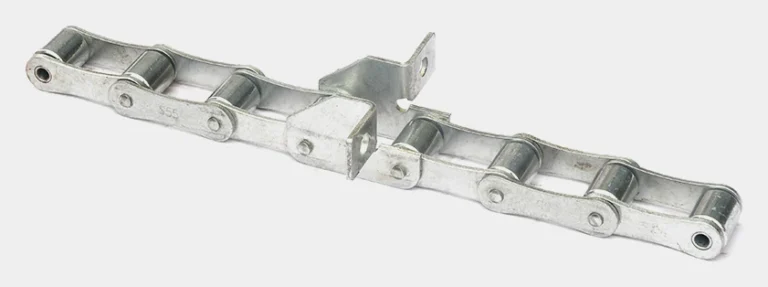
HCC publishes an S55 zinc-plated chain with attachments. In a drawing-led project, the mechanical arrangement and the finish should be separate requirements. The attachment geometry determines the connection to the mechanism; the finish is another part of the ordered specification. Neither should be inferred from the other.
A sample photograph can communicate the general arrangement, but the drawing should define the features that require control. Do not scale an attachment hole position from an image or assume the existing sample is undamaged. If the photograph and drawing disagree, identify the discrepancy and resolve which requirement the proposed part must meet.
Agricultural attachment spacing needs a sequence, not just a close-up
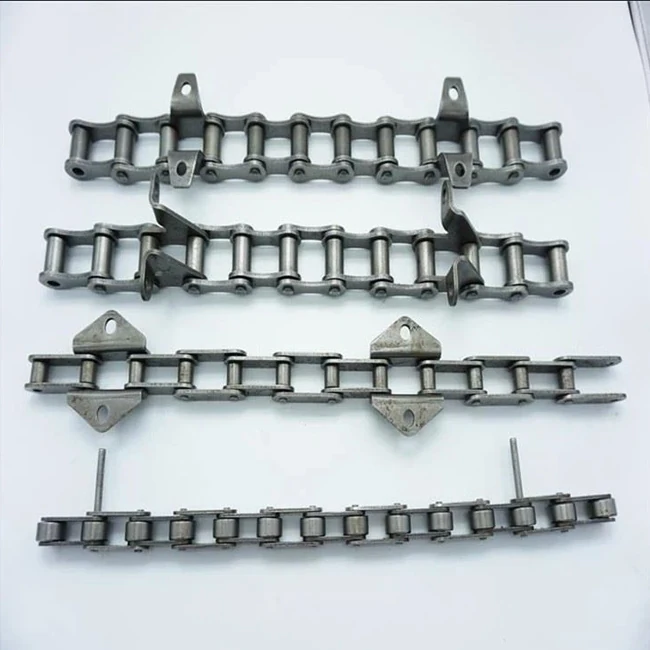
A close-up may show an attachment clearly while leaving its spacing along the chain unknown. The manufacturer needs the intended pattern: where attachments occur, how they are oriented and how the pattern relates to the assembled length. Those details should be shown in a way that remains clear after the enquiry moves from engineering to purchasing.
This issue becomes more important where a machine uses related chains on opposite sides of an assembly. If the equipment design calls for a paired arrangement, provide the relationship between the chains rather than treating them as two unrelated lengths. Any matching requirement should be established by the machine designer and confirmed with the supplier.
Preserve the CA555 C6EJ identity through attachment changes
HCC’s CA555 C6EJ reference is a defined catalogue starting point. If the project requires a change to its attachment arrangement, describe the change explicitly rather than assuming the standard name covers it. The manufacturer should be able to distinguish a repeat catalogue requirement from a proposed non-standard configuration.
For example, an engineering enquiry may use the CA555 C6EJ image to explain the general product family while supplying a drawing for the actual requirement. Label the roles of those two references clearly. Otherwise, the supplier may interpret the catalogue image as the specification while the buyer expects the drawing to govern a different arrangement.
S38-K and S38-F variants require an orientation check
The S38-K / S38-F listing gives buyers another agricultural-chain family to review. The relevant variant and its actual geometry should be confirmed against the mechanism. Where orientation matters, show the direction and working relationship explicitly rather than relying on a photograph taken from an unknown side.
This is not an invitation to invent a universal distinction between the variants from their suffixes. Use HCC’s applicable product information and the machine requirement. If the public description does not resolve a feature, request the drawing or dimensional clarification before treating the variant as approved for the project.
Give the agricultural-chain review both the working run and return path
The chain does not operate only in the position shown in a static product photograph. It travels through the machine’s working and return paths and around the relevant rotating elements. Attachment clearance, supporting surfaces and surrounding components may affect whether the proposed configuration can be used as intended.
A second machinery-builder scenario begins with an attachment that fits correctly in the working position but conflicts with another component elsewhere in the path. The drawing package should show enough of the assembly for that risk to be assessed before production approval. The buyer should not ask a supplier to infer the entire machine from a short chain sample.
Tsubaki’s conveyor-chain overview describes the importance of transport direction, environment and the material being moved. Those are useful general prompts when an agricultural chain serves a conveying function. They do not establish a load rating or application approval for an HCC chain.
HCC also offers M-series conveyor chains, K1 / K2 attachment chains and non-standard chains. These adjacent families can help frame a discussion where the named agricultural product does not describe the whole mechanism. They should be considered as separate candidates, not automatic substitutes for S55, CA555 C6EJ or S38.
Connect HCC’s manufacturing capabilities to the attachment features that matter
HCC presents precision production, heat treatment and assembly resources on its manufacturing page. For an agricultural attachment project, those capabilities are most useful when the buyer identifies the dimensions and assembly relationships that govern fit. A generic request for “good quality” does not tell the manufacturer which feature is critical to the mechanism.
The inspection presentation includes measurement, material examination and mechanical testing. Discuss which evidence is needed for the selected chain and attachment configuration. Do not assume that a company-level inspection capability means every possible custom design has already been tested for the buyer’s application.
A useful acceptance discussion distinguishes geometry from duty. A dimensional check can confirm an attachment’s agreed features. The mechanism’s load and operating suitability require the appropriate engineering assessment. Where mechanical evidence is requested, identify the method, the specimen and the acceptance requirement instead of borrowing a value from another supplier’s catalogue.
For a new custom attachment, the sample review should also identify which features are provisional. If the machine builder is still changing the fixture, do not describe the chain as fully approved. Keep the development status visible so the commercial order does not outrun the engineering decision.
Know when the agricultural-chain request has become a custom project
A request becomes materially different from a catalogue repeat when the buyer changes the attachment geometry, pattern or other defining feature. HCC’s non-standard chain offering creates a route for that discussion. The enquiry should explain the required difference and provide the operating context, rather than attaching the word “custom” to an otherwise incomplete order.
The manufacturer may need more information before it can confirm feasibility or a supply arrangement. That is part of defining the project, not evidence that a catalogue item is unsuitable in every case. Keep the approved standard requirement available as a reference while clearly marking the proposed changes.
HCC’s company profile gives buyers context about the organisation behind the manufacturing relationship. Its overall production capacity should not be interpreted as a dedicated capacity for a new agricultural attachment design. Confirm the review and delivery arrangements for the actual programme.
For commercial planning, separate repeat components from new configurations. A distributor can continue discussing an established S55 requirement while the engineering team resolves a new CA555-related attachment. Combining them in one business relationship does not require treating them as equally ready for production.
Release the agricultural-chain assembly with a drawing the workshop can recognise
Where a sample review leads to a change, update the drawing and the description together. A handwritten note on an S55 sample may help during discussion, but it should not remain the only record of a revised attachment. The production reference needs to capture the final decision so that the next order does not accidentally return to the earlier arrangement.
The same principle applies to paired or directional agricultural assemblies. If the machine design requires a specific relationship between two chains, the order should identify the pair and the relationship that must be maintained. Avoid relying on informal labels such as “left one” without an agreed viewing direction or drawing reference. The aim is not to prescribe a universal naming system, but to make the selected arrangement unambiguous for this machine.
Before release, compare the drawing, sample record and purchase description for contradictions. A CA555 C6EJ reference used as a family illustration should not override a separately approved custom drawing, and a finish note should not conceal a mechanical revision. Resolving these conflicts before production is more efficient than asking the workshop to interpret them after delivery.
The approved record should preserve the base-chain identity, attachment form, orientation, spacing and assembled configuration. It should also identify the current drawing revision. The workshop receiving the chain needs to understand which mechanism it belongs to, not simply which broad agricultural family appears on the invoice.
Where the attachments project beyond the chain body, describe the handling and protection needs for shipment. Confirm the packing arrangement with HCC for the actual geometry and transport route. Do not assume a universal package that is equally appropriate for every attachment pattern or finished length.
Our guide to industrial chain functions is useful when the project team needs to distinguish transmission, conveying and lifting requirements. Keep that functional description in the agricultural assembly file so later purchasing decisions retain the reason the chain was selected.
The final question is whether another engineer could identify the intended assembly from the approved information without guessing at the attachment direction or sequence. If the answer is yes, the manufacturing discussion has a clear foundation. HCC can review a defined agricultural-chain requirement, while the machine builder retains a part record that remains useful beyond the first sample.