

HUANGSHAN CHAIN TECHNOLOGYPart of SFR Group · Established 2011
A Leaf Chain Supplier for Carefully Matched Lifting Replacements

A leaf chain is not a roller chain with the rollers removed from the purchasing description. Its interlaced plates and pins form a different component used in appropriate lifting and tension-linkage systems. Buyers evaluating HCC CHAIN as a leaf chain supplier should begin with the equipment’s approved chain specification, anchor arrangement and application requirements, not a visual estimate of how much load the chain might carry.
HCC includes leaf chains in its industrial and specialist chain range. That provides a starting point for equipment manufacturers and qualified maintenance purchasers. The public listing does not assign an application-specific lifting capacity; the proposed chain must be reviewed against the equipment documentation and confirmed technical information before use.
A leaf chain supplier needs the plate arrangement and pin details
Leaf-chain identification involves more than the outside width of the assembly. The interlaced plate arrangement, pitch, pin geometry and end configuration are part of the component definition. The buyer should obtain the approved designation and drawing where available, then use measurements or samples to support identification rather than replace the equipment record.
Renold’s lifting-chain guide distinguishes leaf chain from roller and bush chain by its construction and engagement. This is useful general background for identifying the product family. Renold’s own ratings and selection tables must not be treated as HCC product data.
Record leaf-chain lacing without guessing a series from the photograph
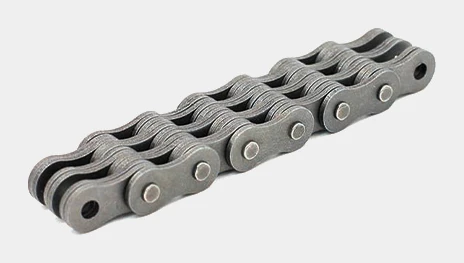
The arrangement of interlaced plates is an important identification detail. A photograph can help show that arrangement, but it may not reveal every layer or dimension. Keep the approved chain reference and relevant drawing with the photographs so the supplier can review a specific requirement rather than infer a series from appearance.
HCC’s public leaf-chain listing does not provide a complete table of every available series and capacity. Do not assign an AL, BL or other designation to the product without confirmation. If the buyer’s equipment documentation specifies a particular reference, provide it and ask HCC to confirm the proposed product’s correspondence.
Keep the leaf-chain replacement tied to the machine, not only the removed part
Imagine a maintenance purchaser receiving a chain sample from equipment whose records are incomplete. The sample may show the general construction, but it cannot establish every aspect of the required replacement. Recover the equipment identity, approved chain information and relevant system details before treating the sample as a complete specification.
This is especially important if the removed part is worn, damaged or of uncertain origin. Its current dimensions may not represent the intended new component, and an earlier replacement may not have been correctly identified. Qualified personnel should resolve the equipment requirement using reliable documentation rather than asking purchasing to approve a chain by resemblance.
Leaf-chain ends and anchors belong in the supply enquiry
The chain must connect correctly to the equipment’s attachment or anchor arrangement. Include the end configuration and relevant interface information in the technical enquiry. A chain length that appears correct does not establish that the ends match the existing system or that the proposed component is approved for it.
Where the scope includes only the chain, state which mating components remain outside the order. Do not assume that the leaf-chain listing includes anchor pins, fittings or a complete lifting assembly. HCC should confirm the actual supplied contents, while the equipment owner remains responsible for the system-level replacement decision.
Related leaf chains should follow the equipment’s replacement requirements
Some equipment uses leaf chains in a related arrangement rather than as an isolated component. The purchasing team should obtain the manufacturer’s requirements for that arrangement and any replacement scope. Do not decide independently to replace only one part of a set or to combine chains with different identities.
The appropriate decision belongs with qualified maintenance or engineering personnel and the equipment’s instructions. HCC can review the defined supply request once the required chain configuration and relationship are clear. This article is not a procedure for lifting-equipment installation, adjustment or inspection.
Leaf-chain supply must not be approved from breaking load alone
A mechanical test value and an allowable equipment duty are not interchangeable. Application suitability depends on the complete system and its design requirements. The buyer should not turn a single strength figure into permission to use a chain for a lifting task, particularly where the figure comes from another manufacturer’s product.
HCC presents mechanical testing and material examination among its inspection capabilities. These resources support a discussion about evidence for a defined chain. They do not establish a universal load rating for every leaf-chain configuration in the catalogue.
For a proposed order, identify the equipment requirement, applicable component specification and evidence needed for review. Any material or mechanical documentation should be associated with the actual chain being supplied. The equipment’s responsible technical authority should determine whether that evidence satisfies the application requirements.
A second buyer scenario involves an importer comparing two chains with similar external dimensions but different supporting documents. The lower price should not decide the substitution before the specifications and approval basis have been compared. Similar appearance and nominal size do not prove that the two products satisfy the same equipment requirement.
Do not substitute HCC roller or conveyor chain for a leaf-chain requirement
HCC’s industrial portfolio also includes 08A / 40 and 16A / 80 roller chains, M-series conveyor chains and K1 / K2 attachment chains. These products broaden the supplier conversation, but they perform different roles and use different constructions. Their presence in one range does not make them substitutes for a specified leaf chain.
Our industrial-chain function guide separates transmission, conveying and lifting discussions. That distinction is useful when a maintenance store purchases several chain types from HCC. Each item should retain its own machine relationship and approval basis rather than being reduced to a general “industrial chain” stock category.
A leaf chain has no rollers for conventional roller-chain sprocket engagement. Its system should be reviewed according to its intended construction and equipment requirements. Do not attempt to redesign a drive or lifting arrangement from the catalogue pictures. A different chain family is an engineering change, not an informal purchasing alternative.
HCC’s non-standard chain offering is another separate route. If the required geometry is not covered by a confirmed standard product, provide the drawing and application context for review. A custom manufacturing discussion does not remove the need for the equipment designer’s approval.
Evaluate HCC’s leaf-chain supply through identifiable products and records
HCC’s production presentation shows precision forming, treatment and assembly resources. The company profile identifies the Huangshan manufacturer and its relationship with SFR. Together, these give buyers a real organisation and manufacturing context to evaluate.
For leaf-chain procurement, connect that context to the selected part. The useful questions concern the confirmed construction, dimensional definition, applicable evidence and supply scope. Avoid replacing those questions with a general request for a certificate that does not identify the chain or explain what was assessed.
Where a sample is reviewed, record its identity and the limits of the review. A sample accepted for dimensional comparison is not automatically approved for operation in lifting equipment. Keep the technical release decision separate and ensure the purchaser understands which approval must exist before the chain is put into service.
Company-wide production capacity may help a buyer understand HCC’s scale, but it does not confirm stock or delivery for a particular leaf-chain configuration. Discuss the required quantity, documentation and timing after the technical requirement is clear. An urgent equipment need should not lead the buyer to skip the identification and approval work.
Preserve leaf-chain identity until the qualified installation team receives it
For an equipment-parts distributor, distinguish a confirmed replacement reference from a chain held only for identification. A sample received from a customer is not automatically a saleable cross-reference. Record the machine information and the approval decision before adding the item to a replacement catalogue. This prevents an uncertain enquiry from becoming a broad compatibility claim that later buyers may rely on.
The same care applies to length descriptions. A measured overall length should be interpreted with the chain configuration and end details, not used as the only basis for a replacement order. The approved technical record should establish how the required assembly is defined. Purchasing should not independently decide how a leaf chain will be shortened, joined or adapted to make an available item fit the equipment.
Where information is missing, a clear unresolved question is more useful than a guessed answer. The buyer may need confirmation of the plate arrangement, the end interface or the exact original reference. Send that question with the available evidence so HCC can review the relevant product information. Keep the equipment out of the purchasing assumption: availability of a visually similar chain does not authorise its use in the machine.
This disciplined identification process is compatible with efficient supply. Once an approved reference exists, subsequent orders can retain the established configuration instead of repeating an uncertain visual comparison. The manufacturer and the buyer then work from the same part identity.
The approved part identity should travel with the supplied chain through receiving and storage. If several chains are visually similar, the store should not depend on a technician recognising them later. Agree the identification and documentation that will allow the receiving team to compare the shipment with the approved order.
Describe any required protection for the transport and storage conditions and confirm the proposed packing arrangement with HCC. Do not assume a particular preservation method or packaging format from the catalogue image. The goal is to receive an identifiable component in the agreed condition, not merely the correct quantity of unmarked chain.
If the delivered item or documents differ from the approved requirement, hold the discrepancy for technical review rather than improvising a substitution. The equipment’s replacement decision should remain traceable to the authorised specification. A supplier relationship is strongest when both parties can identify the exact part and the evidence supporting it.
For the maintenance buyer, the decisive outcome is a leaf chain that has been matched to the equipment through a clear technical process. HCC’s range and manufacturing resources provide a basis for that supply discussion. Bring the equipment reference, plate arrangement, end interfaces and required approval evidence together before releasing the order, and leave installation and return-to-service decisions with the qualified people responsible for the machine.